
ABA-VR E-LEARNING
ABA-VR E-LEARNING 4 Sections19 Lessons15 Quizzes10 Weeks
Lesson 1: Adapting VR Modules to Different Learning Styles and Needs
Incorporating diverse learning styles and needs into Virtual Reality (VR) training modules is crucial to providing a well-rounded and inclusive educational experience, especially when training educators in ABA. ABA educators working in virtual reality environments must have the skills to not only implement ABA techniques, but also to recognize and adapt to their students’ varied learning preferences. Understanding these preferences, whether visual, auditory, or kinesthetic, allows for customization of VR modules to maximize engagement, understanding, and effectiveness.
Integrating ABA principles into virtual reality modules further enhances this personalization, creating opportunities to reinforce, shape, and drive strategies tailored to individual learner profiles. By creating a flexible and adaptable learning environment, virtual reality can address the unique challenges of adult learners, students with special educational needs, and diverse cultural contexts. This section will focus on strategies for adapting VR modules to different learning styles, special needs, cultural diversity, and personalized learning.
Learning styles in the context of virtual reality
Visual learners
Visual learners prefer to interact with material through images and spatial representations. The strength of virtual reality lies in its ability to offer immersive visual experiences that make abstract concepts tangible. For ABA training modules, visual learners benefit from clear, color-coded indications that guide them through the procedures. These prompts can take the form of arrows, highlighted objects, or animated sequences that visually reinforce correct behavior or actions. Visual schedules, interactive diagrams, and flowcharts can further enhance the learning experience by organizing information in a way that is easy to understand and retain.
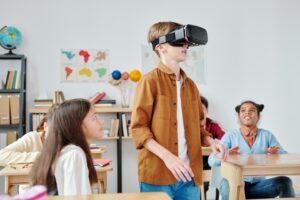
Foto de Max Fischer: https://www.pexels.com/es-es/foto/mujer-en-chaqueta-amarilla-con-botones-de-pie-junto-a-la-mesa-de-madera-marron-5212685/
For example, a VR scenario that teaches task analysis could visually present each step of a complex procedure, ensuring that visual learners can grasp the sequence of actions through interactive and detailed representations (Balakrishnan, 2021). Color-coding of different phases of the task or overlaying visual cues helps students navigate the task and monitor their progress, engaging in an engaging reinforcement of learning outcomes (Ausburn, 2004).
Auditory Learners
Auditory learners excel in environments where information is conveyed through sound and verbal explanations. In virtual reality, these learners benefit from modules that provide detailed audio feedback, such as voiceover instructions or virtual characters that engage learners in dialogue. By incorporating ABA strategies, auditory feedback can be used as positive reinforcement, such as verbal praise or sound effects when learners demonstrate correct behavior. Similarly, the use of auditory cues, such as reminders or spoken instructions, can help guide learners through tasks (Chan, 2010).
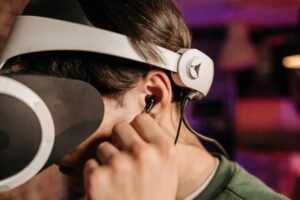
Foto de Pavel Danilyuk: https://www.pexels.com/es-es/foto/persona-auriculares-dispositivo-electronica-7776856/
For example, during VR training on managing challenging behaviors, educators can practice delivering verbal reinforcement or corrective feedback to virtual students, refining their communication skills in the process. The auditory component of these interactions helps auditory learners internalize key ABA techniques more effectively (Lambert, 2023).
Kinesthetic Trainees
Kinesthetic learners benefit most from “learning by doing,” which makes virtual reality an ideal platform to engage them through hands-on interaction. In virtual reality, kinesthetic learners can physically manipulate objects, perform tasks, and practice procedures in a safe and immersive environment. Using ABA principles such as training and task analysis, kinesthetic students can gradually practice new skills through structured step-by-step activities that increase in complexity as they master each level.

Foto de Tima Miroshnichenko: https://www.pexels.com/es-es/foto/jugando-tecnologia-joven-nino-5303587/
For example, in a virtual reality module that simulates a classroom scenario, kinesthetic learners can engage in behavior management by physically interacting with virtual learners, reinforcing appropriate behaviors, and applying intervention techniques. These learners can actively navigate the environment, fostering engagement and helping them to later generalize key ABA strategies through physical interaction (Cercone, 2008).
Adaptation to Special Educational Needs (SEN)
When embracing virtual reality for students with special educational needs, flexibility in sensory input and alternative communication methods is key. Virtual reality environments can be adapted to reduce sensory overload by adjusting elements such as sound, light, or tactile feedback. For students who rely on AAC systems, virtual reality can simulate communication scenarios, allowing practice in real-life situations. For example, a virtual reality classroom environment can allow students to use their AAC device to engage in conversations with virtual classmates or teachers, improving their confidence and communication skills (Balakrishnan, 2021).
In addition, virtual reality’s ability to simulate real-world environments offers a unique opportunity to apply ABA strategies to help students manage anxiety, concentration, and social interactions. For example, visual schedules can be used to describe the day’s activities, offering predictability and reducing stress. Virtual avatars can also model appropriate behaviors, providing clear examples for learners to follow and practice (Lambert, 2023).
Sensitivity and cultural diversity
The adaptability of virtual reality allows for the creation of culturally relevant learning experiences, essential in today’s diverse learning environments. By incorporating characters, environments, and settings that reflect students’ cultural backgrounds, virtual reality can make learning more relatable and inclusive. Offering modules in multiple languages or including culturally specific examples helps break down language barriers and ensures that training is accessible to a wide audience (Bakht, 2011).

Foto de Tara Winstead: https://www.pexels.com/es-es/foto/naturaleza-muerta-conceptual-rompecabezas-puzle-8386114/
ABA educators must also consider cultural contexts when implementing behavioral interventions, as certain behaviors may be viewed differently in different cultures. VR allows educators to practice adapting their ABA strategies to diverse cultural settings, honing their ability to implement interventions in ways that respect and align with cultural norms (Cercone, 2008).
Personalized learning paths in virtual reality
Personalized learning is vital to adapt to individual needs, whether in the context of VR-based ABA training or in the classroom. Virtual reality allows the customization of learning paths based on the student’s progress, adapting to their pace and skill level. For example, in a virtual reality module that teaches crisis management techniques, the difficulty of the scenarios can be adjusted based on the competence demonstrated by the learner, gradually increasing in complexity as the learner masters each level.
By integrating ABA principles such as reinforcement and conformation, VR modules can provide immediate, personalized feedback that helps guide learners toward desired behaviors. The adaptability of VR also allows for continuous assessment, ensuring that each learner’s experience is tailored to their progress and needs (Ausburn, 2004).