
ABA-VR E-LEARNING
ABA-VR E-LEARNING 4 Sections19 Lessons15 Quizzes10 Weeks
Lesson 1: Integrating ABA and VR into Educator Training
An essential challenge in special education is ensuring that educators have the skills to implement evidence-based interventions consistently and accurately. A frequent problem is the transfer of learned skills from one environment to another, which is particularly crucial when working with students with ASD. Educators need a strong theoretical understanding and practical experience to deliver training effectively.
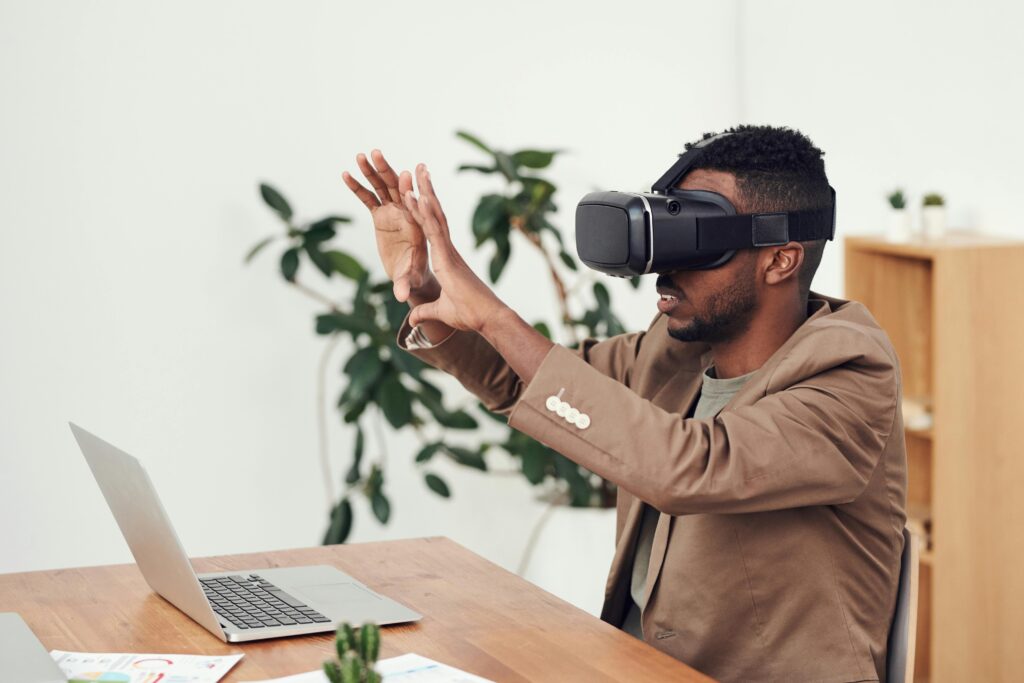
Foto de fauxels: https://www.pexels.com/es-es/foto/hombre-usando-gafas-de-realidad-virtual-3183187/
Section 1: Challenges in Educator Training
The difficulty lies in providing sufficient opportunities for practice and feedback due to limited resources. Universities and colleges often find it challenging to provide varied and reliable field experiences, and “practicing” is unethical. As a result, new teachers are forced to teach with a limited understanding of pedagogy and effective skills, leading educators to look for technological solutions to complement traditional training (Garland, Vásquez III, & Pearl, 2012).
Virtual reality environments have the potential to serve as suitable substitutes for real-world training environments, offering a safer and potentially more efficient training experience. This allows educators to engage in situational training in simulated environments with virtual students, props, and automated feedback, ultimately improving their teaching skills and confidence. Immersive VR simulation platforms are not currently available for consumers’ head-mounted VR displays, such as the Oculus Quest, to teach behavioral intervention skills. Developing such a training simulation platform would offer affordability, ease of use, and flexibility in application. However, despite the potential to improve safety and efficiency, more research is needed on the use of virtual reality technologies to train behavioral interventions (Clay, et al., 2021).
- Staff/Educator Training
Virtual reality solves the challenge of providing educators with consistent and diverse field experiences. Simulated environments, known as “virtual hands-ons,” complement traditional training methods and allow educators to practice teaching techniques in a safe and controlled environment. In addition, technology-based platforms provide a means for educators and supervisors to give feedback to students (Garland, Vasquez III, & Pearl, 2012). VR can be integrated with ABA training using VR technologies in Behavioral Skills Training. BST has proven to be an effective ABA-based training method that includes written and verbal instructions, skill modeling, skills rehearsal, and performance feedback (Sarokoff and Sturmey, 2004).
A similar training procedure, practice-based coaching (PBC), involves instructions, direct observation, and feedback (Mason, et al., 2017). However, a disadvantage of these training procedures is the reliance on scarce resources, specifically for role-playing and the input of a trained professional (Pollard, Higbee, Akers, & Brodhead, 2014). In 2015, it was recommended that future researchers examine delivery options for BST, including technology, to improve diffusion. In the same year, video modelling was incorporated into BST, which has been used to successfully train intervention skills for parents of children with ASD.
Although video modeling has some advantages compared to the traditional method by removing the requirement to have a live model providing instruction, immersive VR training can offer even more advantages by giving the learner the opportunity to engage in whole-body movement and accurately simulate the actions that would be required for an individual when responding to problematic behavior or implementing an intervention to decrease problem behavior (Clay, et al., 2021).
In an immersive virtual reality environment, the learner can rehearse various scenarios repeatedly, improving their confidence and receiving corrective feedback multiple times without direct contact with clients or the need to have accomplices to play with (Garland, Vásquez III, & Pearl, 2012). Another avatar (virtual reality character) could act as a trainer, eliminating the need for a human or live trainer. In this way, students receive feedback after making mistakes without affecting a real child (Sveinbjörnsdóttir, et al., 2019). As learners become more proficient, more complexities can be added within sessions, thus more closely replicating real-world situations. Additionally, the rehearsal in virtual reality may seem more realistic than a role-playing game with an accomplice acting out problematic behavior.
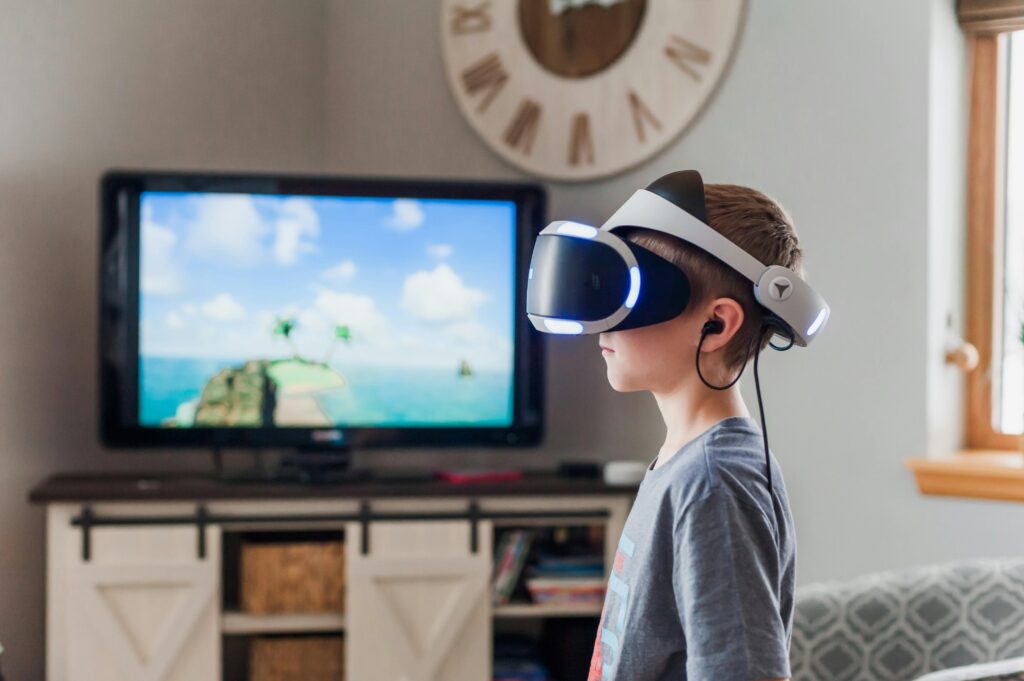
Foto de Jessica Lewis thepaintedsquare: https://www.pexels.com/es-es/foto/nino-con-gafas-de-realidad-virtual-en-blanco-y-negro-3391378/
Practicing with a virtual child/student will help professionals overcome many of the obstacles mentioned above. Both virtual clients have been effectively used to train health professionals and virtual children to train special education teachers in the application of specific teaching methods (Clay, et al., 2021; Sveinbjörnsdóttir, et al., 2019).
- Desensitization: VR exposure therapy (VRET) can effectively treat specific phobias or be used in interventions for desensitization procedures by providing controlled exposure to anxiety-inducing stimuli. The advantage of VRET lies in its ability to manipulate and personalize the exposure experience, making it more manageable and effective than traditional exposure methods. However, based on current research, findings on generalization to real-life situations are limited (Morina, Ijntema, Meyerbröker, & Emmelkamp, 2015).
- Individualized Instruction: Virtual reality allows for individualized instruction. The therapist or coach can tailor the instruction to the student’s needs (e.g., VR environment, task difficulty, level of promptness, reinforcement program, and reinforcer). This individualization improves the effectiveness of interventions by addressing the needs of each user (Carnett, et al., 2023).
- Reinforcement/corrective feedback programs: Real-time feedback in virtual reality environments allows for the scheduling of specific reinforcement programs and corrective feedback, facilitating learning and skill acquisition (Carnett, et al., 2023).
- Prompting/Antecedent Interventions: VR simulations incorporate behavioral analytics components such as antecedent, prompting, reinforcement, and corrective feedback interventions, ensuring comprehensive training experiences. In the study by Carnett et al. (2023), one example explained that additional stimulus cues were included within the VR driving simulation based on the user’s gaze to highlight driving hazards that evoke driver attention and defensive driving maneuvers. In another example, it was explained that the VR system was used in the context of pedestrian safety (visual and auditory stimuli) with a therapist asking questions related to the safety of the situation (e.g., “Is there a car moving?”) and reinforcing the participant’s responses (Carnett, et al., 2023).
- Generalization: VR interventions show promise for promoting generalization of skills by exposing users to diverse character scenarios and skills (multi-example training study) and allowing for additional practice. In addition, VR can also easily allow generalization to the natural environment, as it allows the programming of the relevant stimuli that occur within the natural environment (Carnett, et al., 2023). However, based on current research, the assessment of generalization to natural environments is promising but limited (Clay, et al., 2021).
- Discrete Trial Teaching (DTT): VR training is hands-on for teaching basic DTT skills, providing a hands-on learning experience within a controlled environment (Sveinbjörnsdóttir, et al., 2019).
- Safety skills: Virtual reality simulations offer a safe environment to practice safety skills, such as pedestrian safety and kidnapping prevention, addressing critical functional skills for people with special needs. For example, the use of VR to simulate driving conditions by Cox et al. (2017) can enable safe practice environments that protect the learner, instructor, other drivers, and pedestrians (Carnett, et al., 2023).
Foto de cottonbro studio: https://www.pexels.com/es-es/foto/hombre-escritorio-ordenador-portatil-oficina-7504746/
- Challenging Behavior/Behavioral Functions: Like safety skills, when training behavioral intervention skills, such as managing challenging behaviors, it would be difficult and potentially dangerous to fully simulate challenging behaviors such as aggression. Additionally, training professionals to work with clients who exhibit self-injurious behavior (SIB) can expose the client to potential injury, as repeated SIB frequently leads to physical injury. Exposure to aggression during staff training can lead to an increased risk of exposure to infectious diseases (e.g., coronavirus, severe acute respiratory syndrome [SARS], tuberculosis, hepatitis B) due to proximity to people who may be carriers of a disease. Therefore, practicing functional behavior interventions in VR can eliminate all those risks (Clay, et al., 2021).
- Functional Communication Training (FCT): FCT can be trained using virtual reality technology, reducing risks for trainees. In a study that evaluated the feasibility of using VR to train people to implement TCF for attention and problem behavior maintained by escape, a VR tool (AutSim©) was used. The researchers suggest that future studies should extend this research by examining the application of VR BST to other behavioral functions (Clay, et al., 2021).
- Peer Modeling: Peer modeling (PM) is a peer-mediated behavioral intervention (PMBI) in which a selected peer is instructed to model a desired behavior for the target learner, who is then expected to mimic the behavior in a similar context. With virtual reality, we can create virtual children as pedagogical playmates or learning partners, which has demonstrated its potential as an intervention for children with autism (Tataro & Cassell, 2006).
- Data collection: VR makes it possible to track users’ movements, providing valuable data for decision-making and performance evaluation (Carnett, et al., 2023).
- Skill acquisition: Virtual reality environments provide safe spaces to develop the skills needed for independence and autonomy, reducing the risks associated with real-world practice. Unlike real-world environments, virtual reality can reduce the risks associated with acquiring skills. For example, when learning how to cross the street safely in a virtual reality environment, there are no real risks if the user makes a mistake compared to the real environment, where a person could be hit by a car (Carnett, et al., 2023).