
ABA-VR E-LEARNING
ABA-VR E-LEARNING 4 Sections19 Lessons15 Quizzes10 Weeks
Lesson 5: Implementing Reinforcement and Feedback Techniques
Positive reinforcement for student engagement
In the context of education, positive reinforcement can play a key role in improving student motivation and engagement. Positive reinforcement refers to rewarding a student for performing a desired behavior, thus encouraging the recurrence of that behavior in the future under similar circumstances. In virtual reality, this can take the form of virtual rewards, badges, or verbal praise from avatars after completing a learning task or mastering a new concept. For example, in a virtual reality classroom, students can explore historical events, solve math problems, or conduct science experiments. Upon successful completion of tasks, the system can reward students with virtual trophies or progression points, which can improve motivation. Research shows that positive reinforcement, when combined with the immersive nature of virtual reality, creates a highly engaging learning environment that helps maintain student interest and engagement (Bailenson et al., 2018).

Foto de Anna Shvets: https://www.pexels.com/es-es/foto/mono-divertido-ganar-ganador-6250995/
Positive reinforcement for skill mastery
Virtual reality has proven to be an effective tool for training professionals in complex and high-risk environments. Positive reinforcement in healthcare VR can take the form of progression markers, performance scores, or scenario outcomes that validate correct actions. For example, in a VR module for surgical training, a student that successfully completes a simulated procedure could receive a high score or positive feedback from a virtual mentor, reinforcing the skills acquired during the training (Zhu et al., 2020). Positive reinforcement is crucial because it builds trust and encourages continued practice in difficult procedures, ultimately leading to increased competition in real-world scenarios.
Negative reinforcement to improve learning
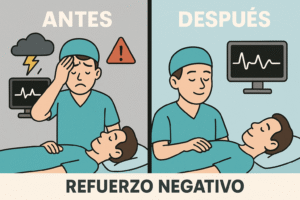
Negative reinforcement in VR can be implemented by removing stressors or negative stimuli when the right actions are taken. In an emergency medical training simulation, trainees may initially experience increased stress as they work on life-saving procedures. As a patient is properly diagnosed and treated, stress-inducing elements such as alarms or critical time constraints can be reduced, rewarding the right decisions and behavior. This allows healthcare professionals to experience high-pressure situations while learning how to respond effectively and manage stress (Ally et al., 2017).
Gamification as a reinforcement strategy
Gamification techniques, such as point systems and leveling, can be integrated into VR to reinforce learning. In a virtual reality language learning environment, for example, students could earn points for correctly pronouncing words or using vocabulary in context. This continuous feedback loop, combined with reward systems, encourages students to improve and engage in repeated practice.
Gamified reinforcement is particularly effective in educational contexts where repeated exposure to the material improves retention. Thus, VR can support active learning strategies through engagement-based reinforcement, promoting a deeper understanding of topics (Lee & Hammer, 2011).
Immediate feedback for skill development
In VR-based learning, immediate feedback is essential to help students correct mistakes in real-time. The immersive nature of virtual reality allows students to receive visual or auditory feedback while performing tasks, making the learning experience more intuitive and responsive. For example, in a virtual reality environment where students learn geometry, immediate feedback might include highlighting errors in the construction of incorrect shapes or measurements, allowing students to correct their approach immediately (Johnson-Glenberg, 2018). The same principle applies in scenarios that contain pedagogical challenges. Again, feedback can be provided immediately, allowing the learner to try different approaches to achieve the most appropriate interaction possible.
Formative feedback for continuous improvement
Formative feedback refers to providing learners with continuous assessments that guide them toward improvement. Virtual reality systems can track student performance and provide formative feedback by analyzing how students interact with the virtual environment. Virtual tutors or AI-powered avatars can help learners by offering suggestions, hints, or clarifications during learning activities. This allows for continuous development without overwhelming students with final assessments.
In pedagogical VR, formative feedback can be particularly valuable in subjects that require critical thinking and problem-solving, such as education in the use of ABA.
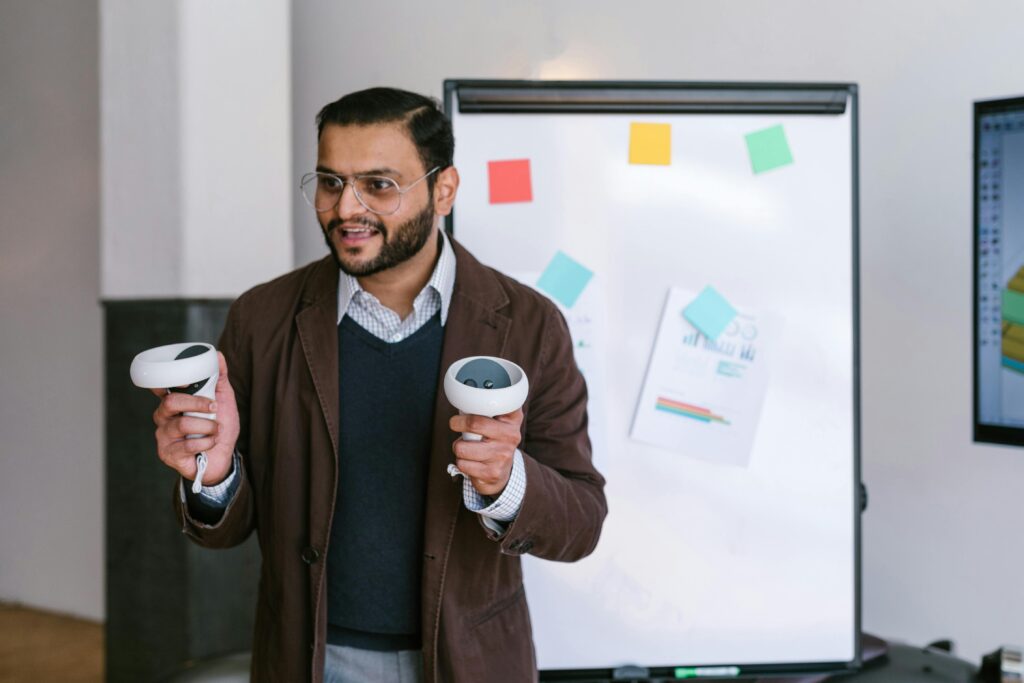
Foto de RDNE Stock project: https://www.pexels.com/es-es/foto/hombre-presentacion-gafas-blazer-7414308/
Immediate feedback on complex procedures
Immediate feedback in virtual reality is particularly valuable because it allows learners to understand the impact of their actions in real time. In a simulation, students can receive instant feedback on their actions. If a mistake is made, the virtual reality system can immediately alert the learner, giving them the opportunity to correct their actions and learn from the mistake (John et al., 2021). The realism of virtual reality simulations, combined with immediate feedback, helps professionals develop technical skills in a safe environment, where mistakes are learning opportunities rather than life-threatening mistakes.
Report
VR training can also provide summative feedback when assessing the learner’s overall performance after completing a module. This feedback can be given through a performance review, a scoring system, or a briefing in which the learner reflects on their actions and results. Summative feedback in VR training helps learners assess their progress and identify areas that require more practice. This approach fosters a growth mindset, in which learning is seen as a continuous process of improvement (Patel et al., 2020).
Benefits of VR-Based Reinforcement and Feedback in Education
Increased student engagement: The immersive nature of virtual reality combined with reinforcement techniques motivates students to stay engaged. This is particularly important in education, where sustained focus and practice are needed to develop expertise.
Safe learning environment: Virtual reality provides a safe environment where learners can make mistakes and receive feedback without real-world consequences. This is crucial in situations where errors in training are preferable to errors in clinical practice.
Improved retention and performance: Reinforcement and feedback, when implemented correctly, significantly improve knowledge and skill retention. This is particularly valuable in situations where mastering complex procedures requires repeated practice.
Personalized learning: Virtual reality systems can tailor reinforcement and feedback to the individual needs of the learner, offering personalized learning experiences. This is beneficial in education, where learners progress at different rates and require different levels of support.