
ABA-VR E-LEARNING
ABA-VR E-LEARNING 4 Sections19 Lessons15 Quizzes10 Weeks
Lesson 6: Introduction to Virtual Reality.
By replacing real-world sensory information with digitally generated content, Virtual Reality (VR) offers interactive, controllable simulations in which therapeutic and learning interventions can be implemented. Ivan Sutherland is widely credited with designing the first head-mounted display (HMD) in 1968, which allowed users to experience a basic wireframed virtual environment. Even though early HMDs were heavy, low-fidelity, and expensive, advancements over the decades have significantly transformed VR technology.

Foto de Eren Li: https://www.pexels.com/es-es/foto/hombre-casa-tecnologia-joven-7241644/
In 2012, Oculus launched a Kickstarter project that promised an affordable, lightweight VR-HMD with 6 degrees of freedom (6DoF) and a wide field of view. This project ushered in a new wave of accessible, high-fidelity VR equipment. Today, immersive and interactive virtual environments are within reach of a large segment of the population, enabling various applications in fields such as mental health and education.
In 2013, a survey of psychotherapy experts ranked VR fourth among the top interventions planned for psychotherapy in 2023 (Glanz et al., 2013). As Albert “Skip” Rizzo highlighted during his keynote address at the IEEE VR 2018 conference, virtual reality applications are becoming essential tools for psychologists, researchers, and practitioners.
Relevance of VR to the project
VR presents an innovative and transformative approach to training adult educators in the application of ABA with autistic children. This technology offers immersive and interactive experiences that can significantly improve the learning process and the practical application of ABA techniques in educational settings. Here’s how virtual reality is relevant to this project:
Increased engagement and motivation:
Virtual reality creates a stimulating and engaging learning environment. Educators can immerse themselves in realistic scenarios that capture their attention and keep them motivated throughout the training process. This increased commitment is crucial to maintaining ABA’s complex principles and strategies.
Safe and controlled practice environment:
One of the significant advantages of VR is the ability to provide a risk-free environment for practicing ABA techniques. Educators can repeatedly practice interventions with virtual children, allowing them to hone their skills without fear of causing harm or experiencing real-world consequences. This controlled environment is particularly beneficial for managing challenging behaviors safely and effectively.

Personalized and adaptive learning experiences:
Virtual reality allows for the customization of training modules to meet the specific needs of individual educators. Training scenarios can be tailored to various skill levels and learning paces, ensuring that each participant receives the most effective instruction tailored to their requirements. This adaptability enhances the overall learning experience and ensures that educators can progress at their own pace.
Practical application and skills transfer:
Virtual reality provides a platform where theoretical knowledge can be applied directly to practical situations. This hands-on approach makes it easy to transfer learned skills to real-world applications. Educators can experience realistic scenarios in the classroom, allowing them to practice and internalize ABA techniques in a way that traditional training methods cannot replicate.
Feedback and evaluation:
In a virtual reality environment, educators receive immediate feedback on their performance, which is crucial for effective learning. Real-time feedback helps educators understand their strengths and areas for improvement, leading to a more complete mastery of ABA techniques. This continuous assessment ensures that educators can hone their skills iteratively, improving their competence and confidence.
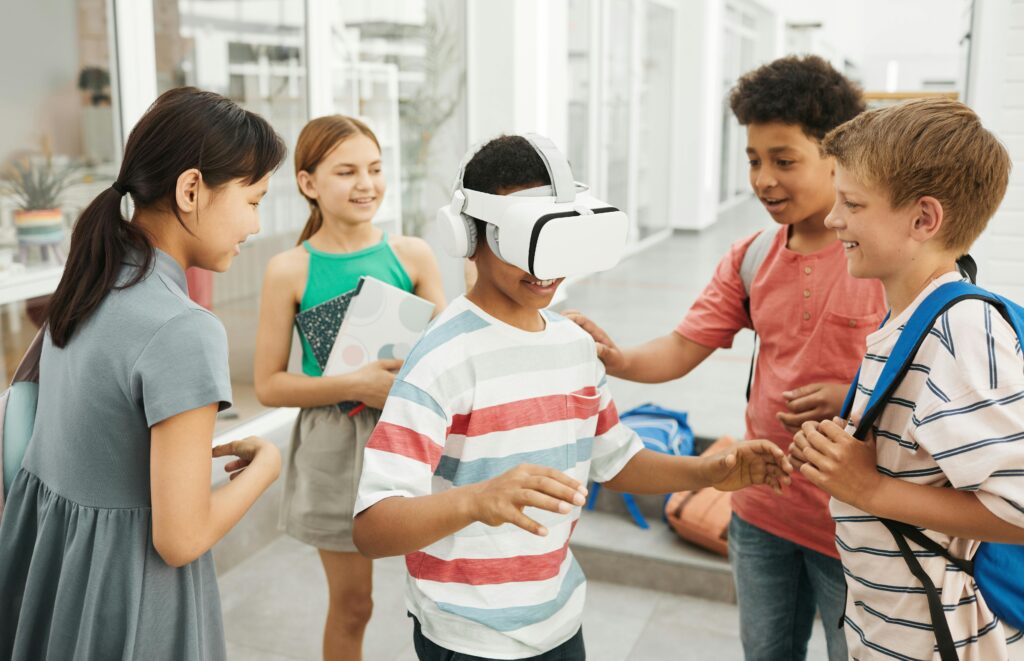
Foto de Norma Mortenson: https://www.pexels.com/es-es/foto/gente-jugando-chicos-muchachos-8457428/
Accessibility and inclusion:
Virtual reality technology can be adapted to accommodate educators with disabilities or limitations, ensuring that everyone has equal access to high-quality training. This inclusion is vital to creating an equitable learning environment where all educators can benefit from training, regardless of their physical abilities.
In summary, integrating VR into the training program for educators using ABA with autistic children offers numerous advantages. It improves engagement, provides a safe practice environment, enables personalized learning experiences, facilitates practical application of skills, offers immediate feedback, and ensures accessibility for all educators. These benefits collectively contribute to more effective and comprehensive training, ultimately improving the quality of education provided to autistic children.