
ABA-VR E-LEARNING
ABA-VR E-LEARNING 4 Sections19 Lessons15 Quizzes10 Weeks
Lesson 1: Design of VR and ABA Based Educator Training Modules
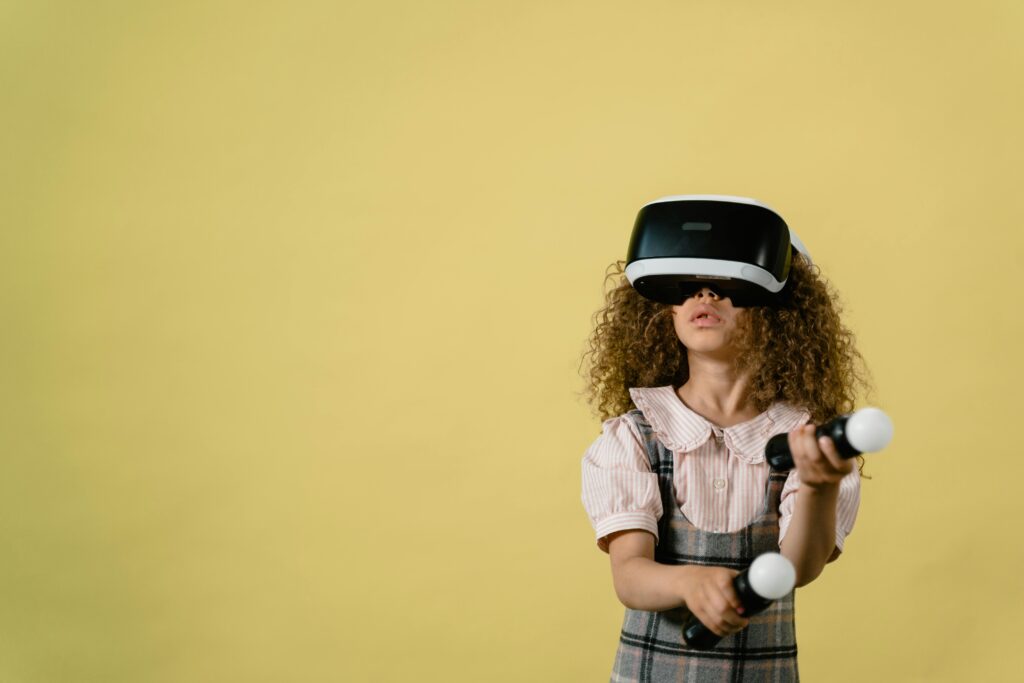
Foto de MART PRODUCTION: https://www.pexels.com/es-es/foto/nina-jugando-joven-juventud-8471967/
Virtual reality in education presents transformative teaching opportunities by immersing learners in highly interactive and experiential environments that are difficult or impossible to replicate in traditional environments. From a pedagogical perspective, VR aligns with constructivist theories, where knowledge is actively constructed through experience and interaction rather than passive absorption. Virtual reality allows learners to interact with abstract concepts in a tangible way, fostering deeper understanding through experiential learning. For example, complex topics such as molecular biology or historical events can be brought to life, allowing students to “enter” a cell or explore ancient civilizations in ways that engage multiple senses. The immersion and realism of virtual reality contribute to greater motivation and engagement, key factors in learning retention. According to Dalgarno and Lee (2010), the spatial presence created by virtual reality environments improves learners’ ability to visualize and manipulate virtual objects, leading to better spatial understanding and problem-solving skills.
In addition, virtual reality supports differentiated learning by allowing for personalized pacing and adaptive environments that accommodate individual learning styles. Kinesthetic learners, for example, benefit from physical interaction with objects in virtual reality, while visual learners can explore detailed 3D simulations. Another crucial didactic consideration is the potential of collaborative learning in virtual spaces. Virtual reality platforms enable multi-user experiences in which students can collectively interact, share ideas, and solve problems, thus promoting theories of social learning, as highlighted by Vygotsky’s (Forman & Cazden, 2013) emphasis on the cognitive theory of multimedia learning suggests that virtual reality, by integrating visual and auditory stimuli, It can help manage cognitive load, allowing students to focus on key concepts without being overwhelmed by superfluous information.

Foto de Kampus Production: https://www.pexels.com/es-es/foto/mujer-ordenador-portatil-oficina-sentado-8636635/
However, special attention should be paid to the learning objectives and the context in which VR is used. Without clear educational goals, virtual reality may be at risk of becoming a novelty rather than an effective learning tool. Educators should design virtual reality experiences with pedagogical intent, ensuring that technology enhances rather than distracts from the learning process. In addition, accessibility remains a challenge, as not all students may have the same access to VR hardware, which could widen the digital divide. Nonetheless, with thoughtful integration, virtual reality has the potential to revolutionize education by creating immersive, engaging, and effective learning experiences.