
ABA-VR E-LEARNING
ABA-VR E-LEARNING 4 Sections19 Lessons15 Quizzes10 Weeks
Lesson 2: Realistic and engaging learning experiences

Foto de ThisIsEngineering: https://www.pexels.com/es-es/foto/codigo-proyectado-sobre-la-mujer-3861969/
Virtual reality allows students to transfer what they learn in the classroom to a real-life situation. According to Aarkrog, transference occurs when a person applies something they have learned in one situation to another more similar situation (Ꜳrkrog, 2010)
VR as a learning tool creates an expansion of the learning space because VR creates access to a virtual practice that students do not have access to in their school classes (Thamdrup, 2020).
From the learning situation to the implementation situation
According to Bjarne Wahlgren, research indicates that only a limited amount of what is learned in a traditional educational program is applied later. However, all education can be improved if it is organized with a greater focus on the application of what has been learned (Wahlgren, 2013).
In a traditional teaching context, organizing lessons to be application-oriented can be challenging. It is essential to structure teaching with a focus on allowing students to transfer what they have learned into new situations, a process known as transfer. Three factors that can promote transfer are personal factors, factors related to teaching, and factors related to the situation in which knowledge should be applied. From a didactic point of view, this means that educators must incorporate real applications of the material learned into the curriculum. In addition, the phases before and after instruction are just as important as the teaching itself. This approach connects to the use of VR in a simulation context, where training is structured with a briefing (before), a VR scenario (during), and a briefing (after). Debriefing, in particular, brings together students’ experiences in the virtual reality scenario through a structured dialogue that encourages self-reflection on their learning. While theory can describe practices, it does not provide students with the experiential understanding of how a given theory is applied in real situations. Virtual reality can simulate practical scenarios to a much greater degree, offering students a meaningful experience of being and acting in those situations. The clearer students can visualize the context of the application, the greater the transfer, as this perception improves their understanding of how learning positively impacts the quality of their future work. The establishment of learning goals is also emphasized to strengthen transfer (Wahlgren, 2013).
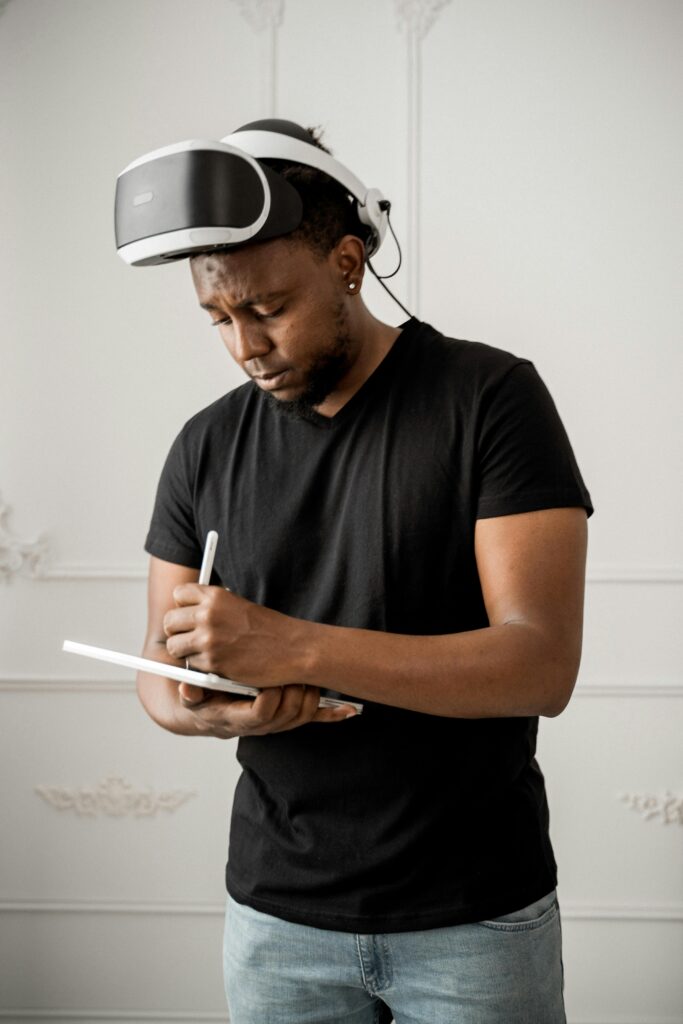
Foto de Tima Miroshnichenko: https://www.pexels.com/es-es/foto/hombre-escritura-escribiendo-tecnologia-5155350/
Practicality and factors that enhance transfer
From a didactic point of view, VR teaching should contain clear learning objectives so that learners know what learning is focusing on. It is important to tailor learning objectives to match the level students are at in your program. This increases the likelihood that students will apply what they learn (Wahlgren, 2013)
In a practice-oriented virtual reality scenario, students will be able to link theory to a practical situation and get a clearer idea of whether the predetermined learning objective is being met. This will be focused during the debriefing after the virtual reality scenario is performed (Simulationsstandarder, n.d.).
Safe and controlled practice environment
Using VR in a teaching situation ensures a safe and risk-free environment in which different approaches to problem-solving, conflict management, communication, etc. can be tested. The use of VR can be of great importance in translating theoretical foundations into practical professional skills. It provides the opportunity to repeatedly evaluate conflicting or challenging situations, with different approaches, without consequences for the student or child with autism spectrum disorder. In the long run, this will give the student confidence in their professional work and their role when faced with unfamiliar challenging situations.
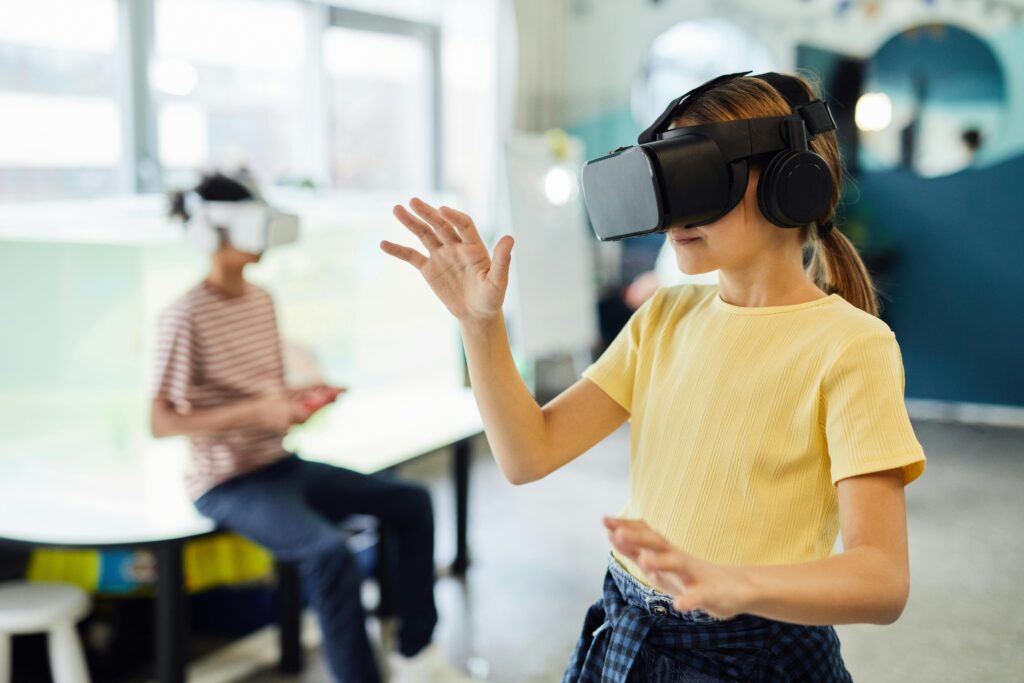
Foto de Vanessa Loring: https://www.pexels.com/es-es/foto/ligero-nina-tecnologia-reloj-de-pulsera-7869238/
When theoretical knowledge has to be transferred to professional practice, it means that it may be necessary to act in practice differently from what the student imagines from the theory (Wahlgren, 2013). The practical shock that some students experience when they encounter a practice that is far from what they imagined can be mitigated in part with the increased use of VR in teaching.
With virtual reality scenarios, we can simulate a practice that will be as close to reality as possible. This will give students more hands-on experience than is possible in a case study, for example. The advantage of virtual reality is that it takes place in a safe learning environment where mistakes are allowed. It is also possible to repeat parts of a scenario or action repeatedly.
In this context, Wahlgren (2013) mentions that the probability that students can apply their competencies in challenging situations is greater than if they had only acquired theoretical knowledge. In other words, the student must be able to see a connection between the learning situation and the application situation. The challenge with classical communication teaching is that it can take a long time before the student realizes that they can link theory with practice. With virtual reality, we can partly encounter the experience of practice right away, in the form of practice-oriented virtual reality scenarios.
Therefore, an important transfer factor is the one related to the situation of the application, i.e. the virtual reality scenario itself. In a virtual reality learning context, this means that immediately after theoretical teaching, students can apply their knowledge in the virtual reality scenario.